
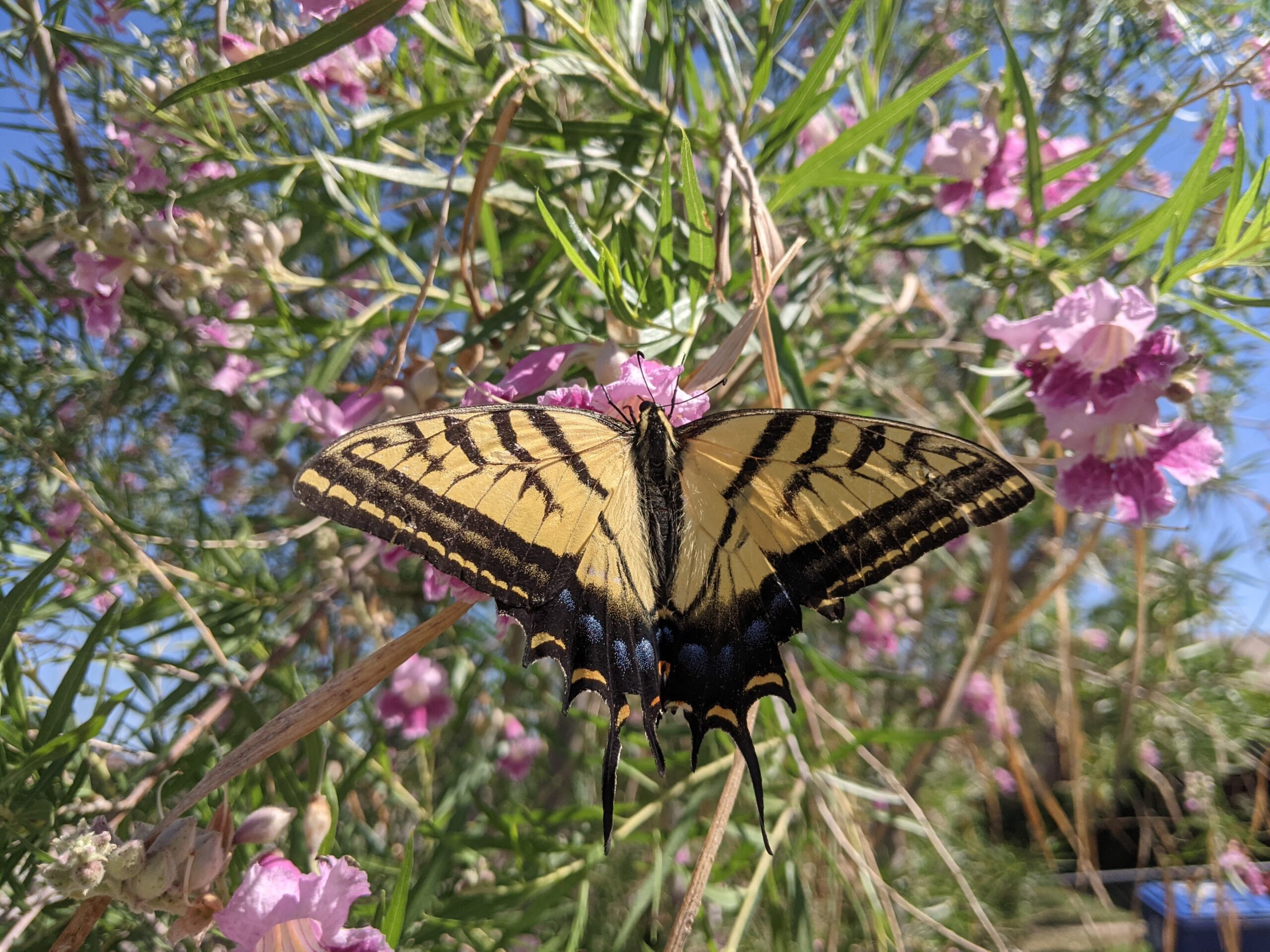
Desert willows provide nectar for pollinators like this two-tailed swallowtail.
Pollinators are an important part of our ecosystem. The pollination services of bees, wasps, butterflies, moths, flies, hummingbirds and bats are necessary for the reproduction of most flowering plants, including the fruits and vegetables we eat. Pollinators and other insects also contribute to the ecosystem by serving as food for a wide variety of other creatures.
Flowering trees provide nectar and pollen for pollinators to eat. The leaves of native trees provide crucial food for caterpillars, which are a key food for birds. The cavities in older trees provide shelter for bees, butterflies and bats.
To help your trees support pollinators:
- Choose native species—see the list below for some of the best. Native pollinators have co-evolved with native trees and many cannot survive without a specific partner.
- Remove weed barrier. Native bees need access to the ground to build their nests, and roots benefit from improved water infiltration.
- Leave fallen leaves on the ground to decompose, or rake them into your compost. Pollinators are spending the winter in those leaves!
- Weed thoughtfully. Native wildflowers provide nectar when your trees aren't in bloom.
- Avoid insecticide and herbicide use. If you must use herbicide, paint it directly on the problematic plant instead of spraying.
- Educate your neighbors about how they can better care for pollinators and trees!
New Mexico native trees with exceptional pollinator value:
Medium to large (20'-50'):
- Desert Willow (Chilopsis linearis)
- Netleaf Hackberry (Celtis reticulata)
- Gray Oak (Quercus grisea)
- Arizona White Oak (Quercus arizonica)
- Gambel Oak (Quercus gambelii)
- Soapberry (Sapindus drummondii)
- Screwbean Mesquite/Tornillo (Strombocarpa pubescens)
- Velvet Mesquite 🏜️ (Neltuma velutina)
- Texas (Eastern) Honey Mesquite ✂️ (Neltuma glandulosa)
- Black Cherry (Prunus serotina)
- Gooding's Black Willow 💧 (Salix goodingii)
- Rio Grande Cottonwood💧 (Populus deltoides wislizenii)
Small (10'-20'):
- New Mexico Olive✂️ (Forestiera pubescens)
- Seepwillow (Bacharis salicina & B. salicifolia)
- Desert Broom 🏜️✂️ (Baccharis sarothroides)
- Desert Scrub Oak (Quercus turbinella)
- Chickasaw Plum (Prunus angustifolia)
- Wild Plum ⛰️ (Prunus americana)
- Chokecherry ⛰️ (Prunus virginiana var.
melomacarpa) - New Mexico Locust (Robinia neomexicana)
- New Mexico (Western) Honey Mesquite ✂️ (Neltuma odorata)
- Catclaw Acacia 🏜️✂️ (Senegalia greggii)
- Frijolito/Mescalbean/Mountain Laurel 🏜️ (Dermatophyllum secundiflorum)
Very small (8'-15'):
- Native sumacs ✂️ (Rhus microphylla, R. trilobata, R. lanceolata & R. glabra )
- Cliffrose (Purshia stansburyana)
- Red Agarita ✂️ (Berberis haematocarpa)
- Creosote bush 🏜️ (Larrea tridentata)
- Mountain Mahoganies (Cercocarpus breviflorus & C. montanus)
- Coyote Willow 💧 (Salix exigua)
Specific needs:
- 🏜️ = Likes heat. Best below 6000'
- ⛰️ = Likes cold. Best above 6000'
- 💧= High water needs.
- ✂️ = Naturally shrubby. Lower limbs can be removed to form a tree.
Plant Lists:
- ABQ Backyard Refuge Plant List
- Xerces Society Plant Lists
- Audobon bird-friendly native plants (filter by trees!)
More resources:
Learn more about how trees are essential habitat for pollinators in the articles below.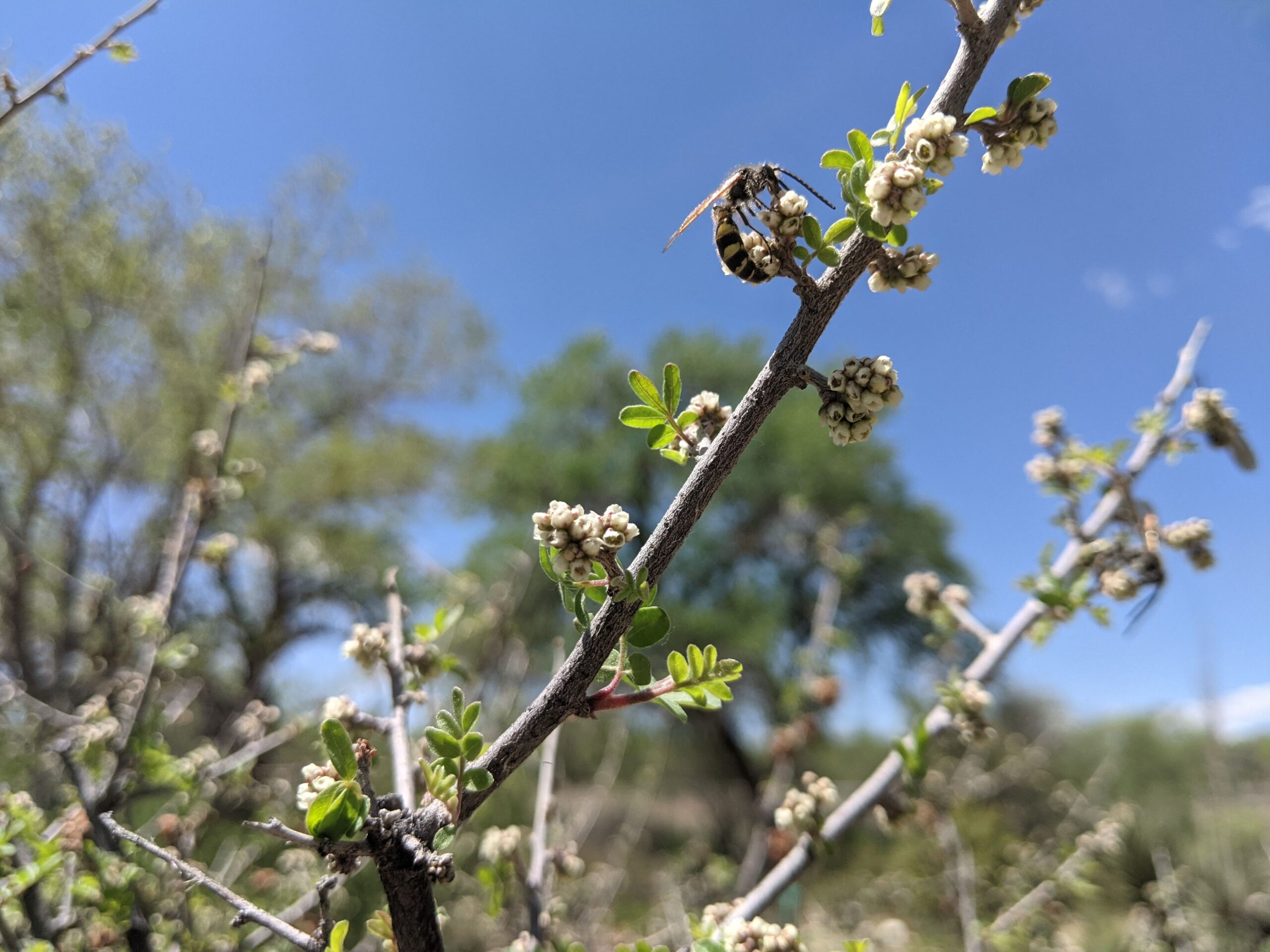
Thanks to pollinators like this wasp, the blooms on this littleleaf sumac will turn into edible berries that can be used as a spice or to make sumac "lemonade." This species is a drought-tolerant shrub that can be pruned into a small tree.
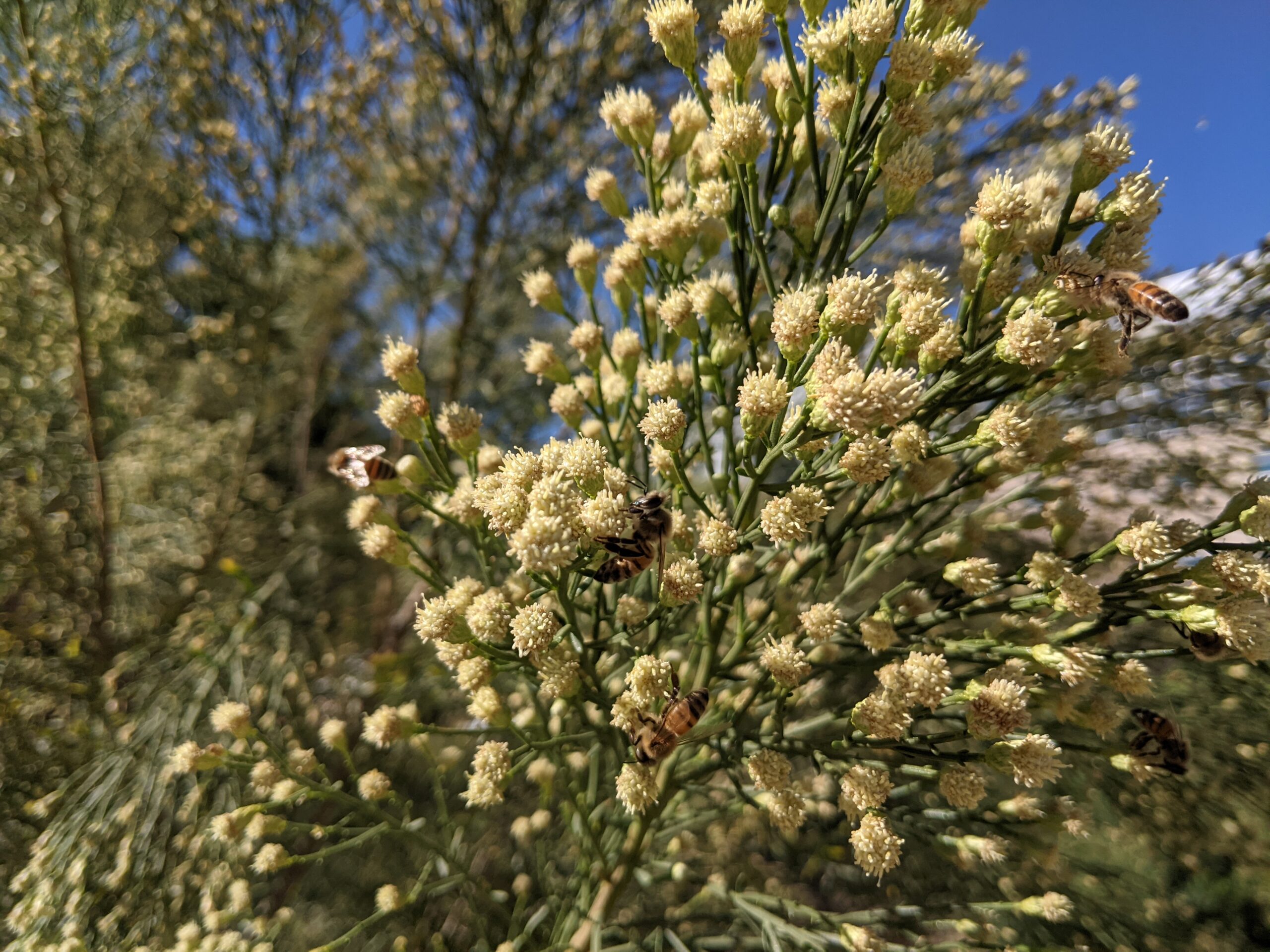
Desert broom is a Southern NM native that provides abundant nectar for honeybees as well as native pollinators.

Seepwillows are a key nectar source in the Middle Rio Grande bosque, supporting countless polinators including these figeater beetles and migrating monarch butteries.